One Click Answers

OCAMoney

Share tool
FacebookPinterestEmail

Gas vs EV Cost Comparison

Would an electric car save me money?

See which vehicle costs less to own over the years you expect to keep it, under the assumptions you enter, and why.

About this tool & how to use it

What the Gas vs EV Cost Comparison does

Compares the cost of owning a gas car and an electric car over the years you expect to keep it, and shows where the cost differences come from.

How to use the Gas vs EV Cost Comparison

  1. Enter how many years you expect to own the vehicle and how many miles you drive each year.
  2. For each vehicle choose Gas or Electric and enter the purchase price and the fuel details. For a gas vehicle that is MPG and the gas price. For an electric vehicle it is efficiency and the electricity price.
  3. Optionally open the extra sections for charging details, financing, incentives and resale value, maintenance, insurance and fees, and other costs. Add a third or fourth vehicle if you want to compare more.
Ownership
Vehicle A
Financing (optional)

Leave blank to compare without financing interest. Only the interest paid during the years you own the vehicle is counted.

Incentives and resale value (optional)

Eligibility for any federal, state, local, utility or manufacturer incentive changes and must be verified separately. Nothing is assumed. Resale value is your own estimate: this page does not predict it.

Maintenance, insurance and fees (optional)
Other costs (optional)
Vehicle B
Financing (optional)

Leave blank to compare without financing interest. Only the interest paid during the years you own the vehicle is counted.

Incentives and resale value (optional)

Eligibility for any federal, state, local, utility or manufacturer incentive changes and must be verified separately. Nothing is assumed. Resale value is your own estimate: this page does not predict it.

Maintenance, insurance and fees (optional)
Other costs (optional)

Enter the years, annual miles, and each vehicle's price and fuel details to compare them.

    Related tools

    Try another answer

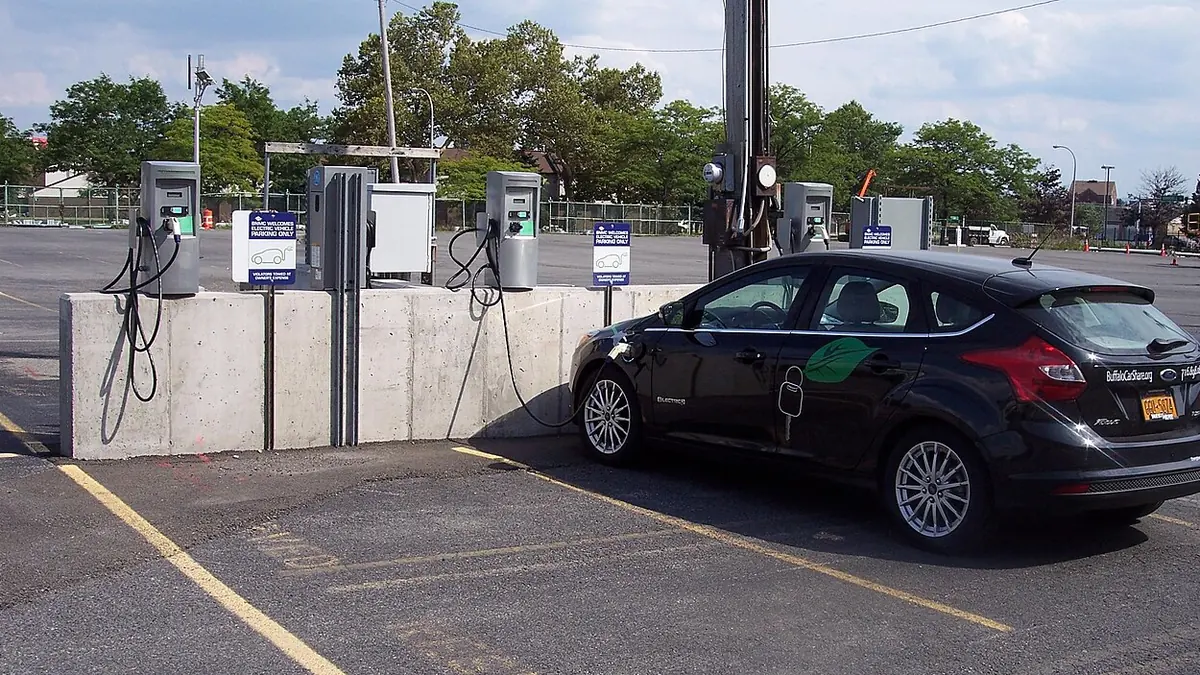
    An electric car plugged in at a row of public charging stations in a parking lot
    Photo: Fortunate4now (CC0, via Wikimedia Commons)

    How we calculated this

    Gas fuel = annual miles / MPG x the gas price. EV battery energy = annual miles / miles per kWh. The energy bought from the grid is the battery energy divided by (1 - charging loss), because charging is not perfectly efficient, and electricity cost = that energy x a price that blends your home and public charging prices by the share of each.

    Ownership cost = purchase price - any rebate or incentive you enter + home charger and other upfront costs + financing interest + (energy + maintenance + insurance + registration + other annual costs) x the years - the resale value you enter. Categories you leave blank are not counted, and the page lists what was left out.

    Financing uses the same tested loan calculation as the Car Loan Comparison: the interest is what you pay in the first months of the loan, up to the years you own the vehicle. The purchase price is shown separately from financing interest.

    Break-even compares the two vehicles month by month. For each month it adds the upfront cost, the interest paid so far and the running costs so far, and finds the first month in which the vehicle that costs more up front is no longer more expensive. This is not one number divided by another, because financing and different yearly costs change the answer. The estimate is shown in years, and the page says so if it does not happen within your ownership period.

    Formulas and details
    • Gas energy per year = annual miles / MPG x gas price.
    • EV energy per year = annual miles / (miles per kWh) / (1 - charging loss) x (home share x home price + public share x public price).
    • Total = purchase - incentive + upfront extras + financing interest while owned + (energy + maintenance + insurance + registration + other annual) x years - resale.
    • Cumulative cost at month m = upfront + interest through month m + yearly running cost / 12 x m (resale is subtracted only at the final month). Break-even = the first month where the higher-upfront vehicle is no longer higher.

    Assumptions

    • Gas prices, electricity prices, efficiency and annual miles stay the same every year. Real prices change, and efficiency varies with temperature, speed, driving style, terrain, heating and air conditioning, towing and load.
    • Incentives are only what you enter, treated as received at purchase. Eligibility for federal, state, local, utility and manufacturer incentives changes and must be verified separately. Nothing is assumed.
    • Charging loss defaults to 10% for an electric vehicle: this is an assumption, not a measurement of your vehicle. You can change it, or set it to 0%. In basic mode all charging is at the electricity price you enter.
    • Maintenance, insurance, registration and resale value are the amounts you enter. Insurance is not estimated from the vehicle type, and resale value is not predicted: future resale values are uncertain.
    • This compares cost only. It does not compare emissions, performance, range, charging convenience or anything else about the vehicles.

    Gas vs EV Cost Comparison example

    Input: 12,000 miles a year for 10 years. Gas vehicle: $32,000, 30 MPG, gas $3.25 a gallon, maintenance $900 and insurance $1,500 a year. EV: $38,000, 3.5 miles per kWh at $0.15 per kWh (no charging loss), maintenance $450 and insurance $1,600 a year.

    Result: Gas energy costs $1,300 a year and EV electricity $514.29 a year. Total ownership cost over 10 years: gas $69,000.00, EV $63,642.86, so the EV has an estimated cost $5,357.14 lower. The EV costs $6,000 more to buy, and its estimated cumulative cost becomes lower after about 5.3 years.

    Gas vs EV Cost Comparison questions

    Does this tell me which vehicle to buy?

    No. It describes the estimated cost of each vehicle under the assumptions you enter. Many other things matter when choosing a vehicle, and none of them are counted here.

    Does it include electric vehicle tax credits?

    Only if you enter an amount. Incentive rules change and eligibility depends on you and the vehicle, so check them separately and enter what you expect to receive.

    Why is there a charging loss?

    Some of the electricity drawn from the grid is lost as heat while charging. The page lets you change the assumption or set it to 0%.

    Why does the break-even look different from my own division?

    Dividing the extra upfront cost by the yearly savings ignores financing interest and any differences in maintenance, insurance and fees. This page adds up the cost month by month instead.

    Can I compare more than two vehicles?

    Yes. Add up to four vehicles. Each can be gas or electric.

    Last reviewed 2026-10-01. Report an incorrect result

    Got another question?

    Free, no account. Answers show how they were worked out.